Sustainability & Ham
Sustainable development in ham production
Local production · Sustainable development · Carbon footprint control · Solar panels: about 30% of our electricity use
Sustainable Development Goals SDGs
The Sustainable Development Goals are the blueprint for achieving a sustainable future for all. They are interconnected and address the global challenges we face every day, such as poverty, inequality, climate, environmental degradation, prosperity, peace and justice. To leave no one behind, it is important that we achieve each of these goals by 2030.

Life Cycle Assessment (LCA)
An LCA considers the complete cycle of a product, process or activity, from its origin as a raw material to the end of its life as waste.
The main objective of the study is to consider every process involved in making the ham, assessing each of the inputs and outputs throughout the product’s life cycle, from its origin (raw material) to its end (product), in order to calculate the carbon footprint, water footprint and environmental footprint generated along the way.
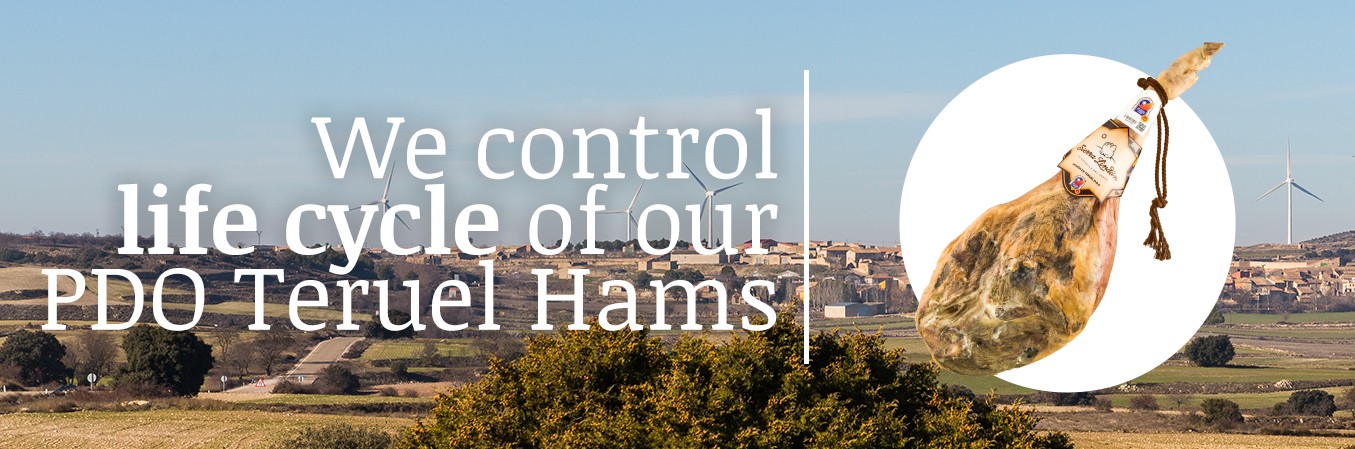
The Protected Designation of Origin “Jamón de Teruel”/“Paleta de Teruel” is the first Designation of Origin in the Spanish meat sector to analyse the life cycle of its Designation of Origin products, as well as to achieve a zero carbon footprint. Its LCA is “cradle to gate”: the study excludes marketing, distribution and consumption, as well as business and employee travel.
The aim is to implement a sustainability strategy that achieves several goals:
- Contribute to the 2030 Agenda targets: the Sustainable Development Goals.
- Get ahead of the bioeconomy challenges in Aragon and Spain.
- Increase sustainability.
- Strengthen companies’ resilience to climate change.
- Shift the sector towards sustainability.

Environmental footprint
The environmental footprint of a product measures its environmental impact throughout its life cycle, whether direct or indirect. The aim of this indicator is to minimise environmental impact.
Water footprint
The water footprint quantifies water consumption across the whole product cycle, giving a more complete analysis of its life cycle. In this LCA, it covers all the activities carried out at each stage of production.
Carbon footprint
The carbon footprint measures a product’s impact in terms of the total greenhouse gases (GHG) emitted, directly or indirectly.
Following the Life Cycle Assessment of Teruel PDO ham, we decided to calculate our own carbon footprint and registered it in the Carbon Footprint Registry of the Spanish Ministry for the Ecological Transition and the Demographic Challenge.
“Calculo 2025” seal from the Carbon Footprint Registry of the Spanish Ministry for the Ecological Transition and the Demographic Challenge.
Want to know more? Read our article on sustainability in the ham sector (in Spanish).
Knowing our footprint allows us to take steps to improve our facilities and production processes. We are evolving and we are sustainable.
